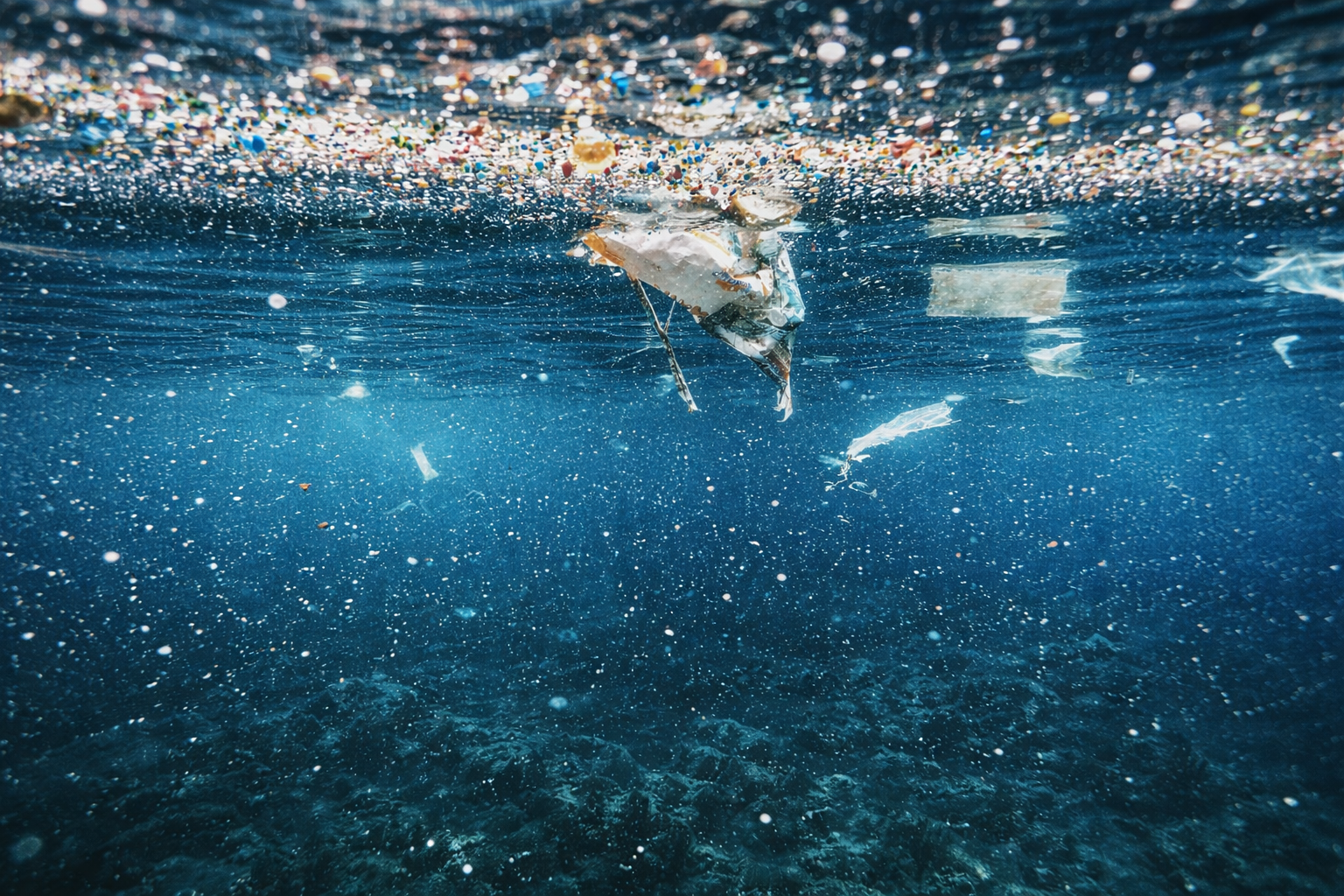
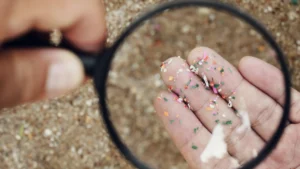
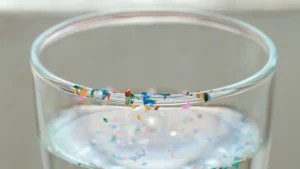
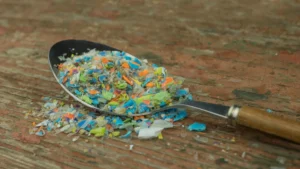
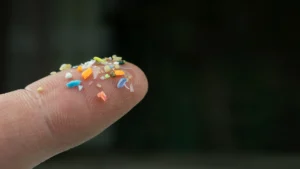
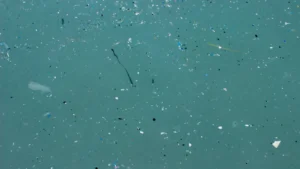
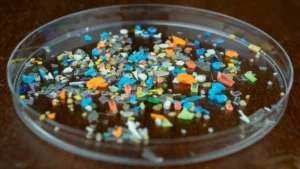
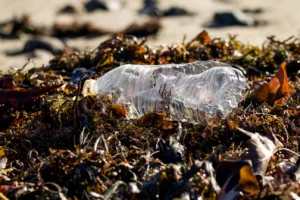
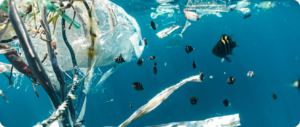
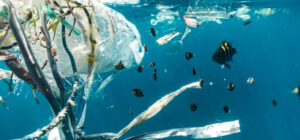
When people hear the phrase microplastic soup, they often envision floating islands of bottles and bags drifting across the sea. The reality is both more complex and more concerning.
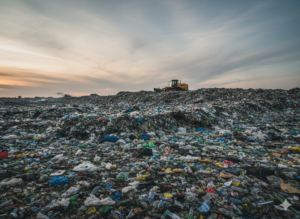
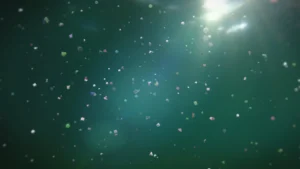
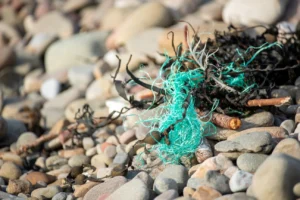
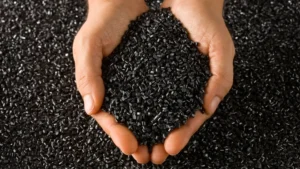
Microplastic soup describes the growing concentration of plastic debris circulating through our oceans, rivers and lakes. Some of it is visible fragments of packaging, abandoned fishing gear, and lost containers. But much of it is microscopic. Tiny particles suspended in seawater, interlaced within marine ecosystems from the surface to the seabed¹.
It is called a “soup” because it isn’t one solid mass. It’s dispersed, mixed, and stirred continuously by the wind, tides and currents. And once it’s there, it is incredibly difficult to remove².
The Great Pacific Garbage Patch And What It Really Means
One of the most well-known examples of plastic accumulation is the Great Pacific Garbage Patch.
Located in the North Pacific Gyre, roughly between Hawaii and California, this vast zone of circulating currents traps marine debris³. Plastic drawn in by ocean circulation patterns gradually accumulates in the centre of the gyre.
Research suggests the patch covers roughly 1.6 million square kilometres⁴, although its boundaries shift constantly. Much of the mass is fragmented plastic rather than whole items.
Over time, larger plastics break down under sunlight, wave action and saltwater exposure. They do not biodegrade; they fragment into smaller and smaller particles⁵.
Which means the Garbage Patch is not simply a floating landfill. It is also a reservoir of microplastics.
And similar accumulation zones exist in other ocean gyres around the world⁶.
Where Does Microplastic Soup Come From?
Microplastic soup does not begin in the middle of the ocean. The majority of marine plastic pollution originates from land-based sources⁷. It can enter waterways through:
- Inadequate waste management systems
- Overflowing landfill sites
- Illegal dumping
- Urban runoff
- Stormwater systems
- Rivers carrying waste downstream
Tourism, maritime industries and fishing activity also contribute, particularly through lost or discarded fishing gear⁸.
Once plastic reaches open water, currents can transport it thousands of miles⁹. Then there is a less visible source, the ones that start much closer to home.
The Microplastic Layer Beneath the Surface
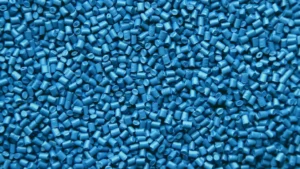
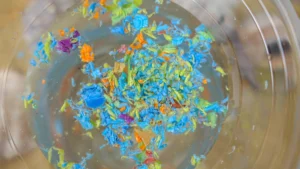
As plastic fragments, it forms microplastics, particles smaller than 5 millimetres¹⁰. But not all microplastics are formed in the sea.
One of the largest contributors to primary microplastic pollution is synthetic textiles¹¹.
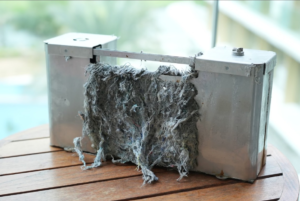
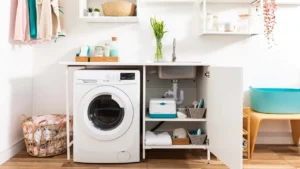
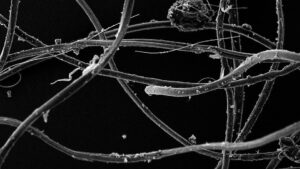
Every time we wash clothes made from threads such as polyester, nylon, acrylic or elastane, microscopic fibres shed. A single wash cycle can release hundreds of thousands of fibres into wastewater¹².
Treatment plants capture some, but many pass through filtration systems and enter rivers and oceans¹³. Others accumulate in sewage sludge, which may later be spread on agricultural land, creating another pathway into the environment¹⁴.
Plastic soup is not just a consequence of litter. It is also a by-product of daily life.
Microplastics and the Ocean’s Carbon System
Microplastics are no longer confined to polluted coastlines or heavily industrialised regions. They are now found throughout marine environments, from surface waters to deep-sea sediments. And as global plastic production continues to rise, concentrations in the ocean are expected to increase over time.
What is less often discussed is how this pollution intersects with one of the ocean’s most important climate processes: the biological carbon system.
At the centre of this system are two microscopic powerhouses.
Phytoplankton: The Ocean’s Oxygen Makers
Phytoplankton occupy the sunlit surface layers of the ocean, suspended in water where light is strong enough to power photosynthesis. Using that light, they draw carbon dioxide out of the atmosphere and release oxygen as a by-product. Collectively, these microscopic organisms are thought to generate roughly half of the oxygen we breathe.
They are too small to see individually, yet their influence is massive. Remove them, and the chemistry of our planet, and the stability of life on it, would change dramatically.
Zooplankton: Carrying Carbon Downwards
Zooplankton feed on the phytoplankton and other tiny organisms and they become part of a natural transfer system that moves carbon through the ocean. As they feed, breathe, release waste and eventually die, the carbon stored in their bodies is gradually carried down into deeper layers of the ocean.
This continual sinking of organic material forms part of what scientists call the biological carbon pump. It is a quiet but powerful process that draws carbon away from the atmosphere and stores it in the ocean’s depths, sometimes for hundreds of years. Without it, atmospheric carbon levels would be significantly higher.
Where Microplastics Enter the Picture
Researchers are now exploring how microplastics may be disrupting this finely tuned system.
Laboratory studies suggest that tiny plastic particles can cling to phytoplankton cells. When this happens, it can reduce the amount of light reaching the cell surface, potentially interfering with photosynthesis. Even small reductions in efficiency matter when organisms at this scale underpin global oxygen production.
Zooplankton are now consuming microplastics, often confusing them for food. Ingested plastic provides no nutritional value and may alter feeding behaviour or reduce energy intake. Over time, this could affect how efficiently carbon and energy move through the marine food web.
There are further questions about what happens when plankton die. Normally, their remains contribute to “marine snow” — a steady fall of organic particles that transport carbon into the deep ocean. If buoyant plastic fragments become entangled in this material, they may influence how it sinks, potentially slowing the process that locks carbon away.
Research is ongoing, and many uncertainties remain. What is becoming increasingly clear, however, is that microplastics are not confined to beaches or surface waters. They are interacting with some of the ocean’s most fundamental life-support systems — systems that regulate oxygen production and help stabilise the global climate.
Why This Matters
Plastic pollution harms marine life in obvious ways, such as entanglement, ingestion, and injury. But the less visible impacts may be just as significant.
Microplastics move through the food web, beginning with plankton and travelling upwards to fish, marine mammals and ultimately humans. They have been detected in seafood, drinking water and even human blood samples.
The consequences are ecological, economic and potentially climatic.
The durability that once made plastic so useful now means it persists, fragmenting, circulating and accumulating.
The ocean remains one of our greatest allies in regulating climate and supporting life. Protecting it is not simply an environmental aspiration. It is a practical necessity.
Why Ocean Clean-Up Alone Won’t Solve It
Once plastic fragments into microscopic particles dispersed across vast areas, removal becomes extraordinarily difficult²⁸. We cannot filter the ocean. Which means prevention, stopping plastic before it reaches open water, is essential.
What Can Be Done?
Solutions already exist.
- Strengthening global waste infrastructure²⁹
- Reducing single-use plastics³⁰
- Capturing microfibres at source³¹
- Developing circular systems for recovered materials³²
- Supporting international cooperation, including the UN Global Plastics Treaty negotiations³³
The path forward is upstream, from Crisis to Responsibility. The growing plastic soup in our oceans is one of the major environmental challenges of our time, but it doesn’t have to be our future.
The ocean’s carbon pump, its biodiversity, and its ability to stabilise our climate are extraordinary systems. They have regulated life on Earth for millions of years.
Protecting them requires intention, innovation and shared responsibility. The soup may be global. But the solutions start upstream.
References
1, 2, 9, 27, 33: United Nations Environment Programme (UNEP) (2021).
From Pollution to Solution: A Global Assessment of Marine Litter and Plastic Pollution.
https://www.unep.org/resources/pollution-solution-global-assessment-marine-litter-and-plastic-pollution
UNEP (2016).
Marine Plastic Debris and Microplastics: Global Lessons and Research to Inspire Action.
https://www.unep.org/resources/report/marine-plastic-debris-and-microplastics
UNEP (2014).
Valuing Plastics: The Business Case for Measuring, Managing and Disclosing Plastic Use.
https://www.unep.org/resources/report/valuing-plastics-business-case-measuring-managing-and-disclosing-plastic
UN Environment Assembly.
Global Plastics Treaty Negotiations.
https://www.unep.org/inc-plastic-pollution
2, 5, 10: NOAA Marine Debris Program.
What are microplastics?
https://oceanservice.noaa.gov/facts/microplastics.html
3, 4: Lebreton, L. et al. (2018).
Evidence that the Great Pacific Garbage Patch is rapidly accumulating plastic.
Scientific Reports.
https://www.nature.com/articles/s41598-018-22939-w
6: 5 Gyres Institute.
Global Plastic Pollution Research.
https://www.5gyres.org
7: Jambeck, J. et al. (2015).
Plastic waste inputs from land into the ocean.
Science.
https://www.science.org/doi/10.1126/science.1260352
8: Food and Agriculture Organization (FAO) (2018).
Abandoned, Lost and Otherwise Discarded Fishing Gear (ALDFG).
https://www.fao.org
11, 31: IUCN (2017).
Primary Microplastics in the Oceans: A Global Evaluation of Sources.
https://portals.iucn.org/library/node/46622
12: Napper, I. & Thompson, R. (2016).
Release of synthetic microplastic fibres from domestic washing machines.
Marine Pollution Bulletin.
https://www.sciencedirect.com/science/article/pii/S0025326X16303600.
13: Carr, S., Liu, J., & Tesoro, A. (2016).
Transport and fate of microplastic particles in wastewater treatment plants.
Environmental Science & Technology.
https://pubs.acs.org/doi/10.1021/acs.est.6b02329
14: Nizzetto, L. et al. (2016).
Are agricultural soils dumps for microplastics of urban origin?
Environmental Science & Technology.
https://pubs.acs.org/doi/10.1021/acs.est.6b00229
17: NASA Earth Observatory.
Phytoplankton and the Ocean’s Oxygen Production.
https://earthobservatory.nasa.gov/features/Phytoplankton
18: IPCC (2021).
Sixth Assessment Report – Ocean Carbon Uptake.
https://www.ipcc.ch/report/ar6/wg1/
19: Bhattacharya, P. et al. (2010).
Physical adsorption of charged plastic nanoparticles affects algal photosynthesis.
Journal of Physical Chemistry C.
https://pubs.acs.org/doi/10.1021/jp1054759
21: Porter, A. et al. (2018).
Microplastic interactions with marine snow.
Environmental Science & Technology.
https://pubs.acs.org/doi/10.1021/acs.est.8b01080
22: Gall, S. & Thompson, R. (2015).
The impact of debris on marine life.
Marine Pollution Bulletin.
https://www.sciencedirect.com/science/article/pii/S0025326X14005698
23: Cole, M. et al. (2013).
Microplastic ingestion by zooplankton.
Environmental Science & Technology.
https://pubmed.ncbi.nlm.nih.gov/23847934/
24: European Food Safety Authority (EFSA).
Microplastics in food.
https://www.efsa.europa.eu
25: World Health Organization (WHO) (2019).
Microplastics in Drinking-water.
https://www.who.int/publications/i/item/9789241516198
26: Leslie, H. et al. (2022).
Discovery and quantification of plastic particle pollution in human blood.
Environment International.
https://www.sciencedirect.com/science/article/pii/S0160412022001258
28: The Ocean Cleanup.
Why removing microplastics from the ocean is difficult.
https://theoceancleanup.c
29: OECD (2022).
Global Plastics Outlook.
https://www.oecd.org/environment/plastics
30: European Commission.
Single-Use Plastics Directive.
https://environment.ec.europa.eu/topics/plastics/single-use-plastics_en
32: Ellen MacArthur Foundation.
The New Plastics Economy.
https://ellenmacarthurfoundation.org